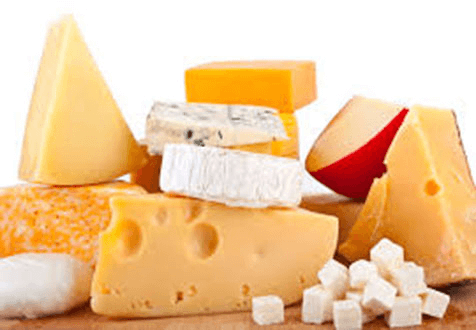
Processed Cheese (Pizza)
Processed cheese is made from one or a mixture of several types of cheese with varying degrees of ripening, combined with allowed emulsifiers and heated under appropriate conditions while stirring to obtain a uniform mixture. In addition to the aforementioned ingredients, optional materials can also be used in the production of processed cheese.
Steps of Making Initial Cheese:
(The method of using pasteurized milk is optional.)
1- Separation of fat.
2- Pasteurization (optional).
3- Adding starter (optional).
4- Cheese mixture.
5- Cutting the curd.
6- Separating the whey.
7- Washing (1 step with hot water and 2 steps with cold water).
8- Achieving a cauliflower-like appearance.
9- Transfer to refrigeration.
Factors Affecting Raw Milk until Entry into the Factory on the Quality of Initial Cheese:
1. Type of animal
2. Cow breed
3. Age
4. Nutrition
5. Milking period
6. How milk is delivered to the factory (one or two times)
7. Production on the day milk is received or the next day
8. Storage temperature
9. State of the milk tank mixers (horizontal, vertical, number of rotations)
10. Method of fat adjustment (temperature, separator)
11. Method of pasteurization (temperature, time) (optional)
12. Temperature of milk entering the factory
13. Fat – Dry matter – Protein – Acidity
The Effect of Acidity of Raw Milk on the Quality of Initial Cheese:
1. Melting ability (the amount of salts (calcium) is inversely related to melting ability)
2. Yield (higher acidity reduces yield)
3. Softness (if the acidity is low, due to the increase in water and presence of microbial growth inhibitors)
4. Whey separation (occurs if the acidity is low)
5. White color
6. Cheese color after cooking:
Burnt (dark brown)
The Effect of Dry Matter in Raw Milk on the Quality of Initial Cheese:
1. Yield: Increasing dry matter increases yield.
2. Melting ability
3. Chewability: This occurs when there is an imbalance between dry matter and fat.
The Effect of Protein Level in Raw Milk on Initial Cheese Quality:
1. Yield: Increasing protein levels and the ratio of casein to water-soluble proteins increases yield.
2. Whey separation: The ability of milk proteins to absorb and retain water increases with acidity (lowering pH).
3. Fat separation from texture: The protein level and pH in initial cheese are important for maintaining fat content in the product.
The Effect of Fat in Raw Milk on Initial Cheese Quality:
1. Yield
2. Fat separation from texture
3. Fat separation after pizza baking
4. Sharpness
The Effect of Microbial Content in Raw Milk on the Quality of Initial Cheese:
1. Taste and odor
2. Softness
3. Bitterness (proteolysis)
4. Gas formation (bubbles in cheese)
5. Rindability
The Effect of Calcium Level in Milk and Calcium Chloride (If Pasteurized) on the Quality of Initial Cheese:
If pasteurized milk is used for initial cheese, calcium is added to the milk.
The Effect of Starter (If Pasteurized Milk Is Used) on Initial Cheese Quality:
1. Thermophilic or mesophilic
2. Amount of starter used
3. Acid-producing capacity
4. Proteolysis
5. Inactivation of starter
The Effect of Cheese Rennet on Initial Cheese Quality:
1. Type
2. Amount
3. Coagulation power
4. Rennet residue
5. Inactivation of rennet
The Effect of Rennet Temperature on Initial Cheese Quality:
Differences in rennet temperature cause the formation of curds, different tastes, and aromas in the products.
The Effect of Curd Formation, Cutting, and Room Temperature on Initial Cheese Quality:
Cutting time, piece size, and room temperature affect moisture, pH, yield, taste, and other quality aspects.
The Effect of Curd Storage Temperature on Initial Cheese Quality:
It affects moisture, pH, taste, and color of the product.
The Effect of Curd Treatment (Washing) on Initial Cheese Quality:
Quality, temperature, and number of washings of curd with hot water affect stretchability, taste, texture softness, pH, etc.
The Effect of Cooling Rate on Initial Cheese Quality:
It affects texture softness (surface layers of the product) and fat separation inside the packaging.
The Effect of Storage Temperature on Initial Cheese Quality:
It affects taste, aroma, texture, etc.
Steps for Making Pizza Cheese (Briefly):
Choosing the cheese, calculating raw material components.
Mixing.
Increasing emulsifiers.
Thermal operations.
Molding.
Cooling.
Storage in refrigeration.
Factors Affecting the Production Method and Quality of Pizza Cheese:
Home consumption
1. Product type for consumption
Pizza shops
2. Piece size (smaller and more suitable)
3. Ratio of different ingredients in the formulation (waste of white cheese, cream, butter, ricotta, vegetable oil, pre-cooked waste)
4. Amount of melting salts
5. Type of melting salts (citrates, phosphates, mixtures)
6. Method of addition (dry – dissolved in cream – post-churned milk – water)
7. Time of addition (beginning of cooking – multi-stage during cooking)
8. Stirring speed
Direct heat under the blender (vertical): Limits to providing high temperatures over 65°C
9. Cooking temperature (with steam): Without lid
Horizontal cooking pot (with steam): With lid and the ability to provide relatively high temperatures (90-80°C)
10. Cooking time
11. Cooling method